<?xml version="1.0" encoding="UTF-8"?>
<?xml-stylesheet href="/rss.css" type="text/css"?>
<rdf:RDF xmlns="http://purl.org/rss/1.0/"
    xmlns:cc="http://web.resource.org/cc/"
    xmlns:dc="http://purl.org/dc/elements/1.1/"
    xmlns:extra="http://www.w3.org/1999/xhtml"
    xmlns:prism="http://prismstandard.org/namespaces/1.2/basic/"
    xmlns:rdf="http://www.w3.org/1999/02/22-rdf-syntax-ns#">
    <channel rdf:about="http://www.immijournal.com/feeds/latestarticles/journal?quantity=&amp;format=rss&amp;version=">
        <title>Integrating Materials and Manufacturing Innovation - Latest Articles</title>
        <link>http://www.immijournal.com</link>
        <description>The latest research articles published by Integrating Materials and Manufacturing Innovation</description>
        <dc:date>2013-04-26T00:00:00Z</dc:date>
        <items>
            <rdf:Seq>
                                <rdf:li rdf:resource="http://www.immijournal.com/content/2/1/1" />
                                <rdf:li rdf:resource="http://www.immijournal.com/content/1/1/3" />
                                <rdf:li rdf:resource="http://www.immijournal.com/content/1/1/2" />
                                <rdf:li rdf:resource="http://www.immijournal.com/content/1/1/1" />
                            </rdf:Seq>
        </items>
                 <cc:license rdf:resource="http://creativecommons.org/licenses/by/2.0/" />
    </channel>
        <item rdf:about="http://www.immijournal.com/content/2/1/1">
        <title>Partnership for accelerated insertion of new technology: case study for thermal spray technology</title>
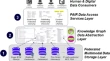
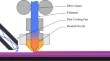
        <description>IntroductionMaterials and manufacturing innovation in complex engineering systems such as those in aerospace, energy, heavy machinery is extremely challenging as they typically involve lengthy and costly development cycles and generally follow stringent guidelines and defined road maps. Incorporating academic science and disruptive advances into this product development cycle is challenging. Effective partnerships via integrated academic-industry study groups and joint value proposition of scientific advances and models, can accelerate insertion of new knowledge/technologies in this class of materials and manufacturing ecosystems.Case DescriptionThis paper describes such a partnership and integration framework through exemplary case studies in thermal spray materials processing. Thermal spray is a platform materials manufacturing technology enabling deposition of advanced coatings for wide range of materials applications in aerospace, energy, heavy machinery, electronics and biomedical devices. It is a complex process involving many facets of engineering sciences including thermo-fluids, heat transfer, materials science and mechanics, incorporating non-equilibrium phenomena and multi-scale structure/behavior. The required breadth and depth of process and materials knowledge for advancing the technology is very significant, resulting in lengthy, trial and error based developments.Specific case studies illustrate knowledge advancement through science and models, development of measurement tools and simulations, along with industrial demonstration studies, addressing the utility in the manufacturing enterprise. Together, they represent a framework for establishing integrated computational and experimental materials engineering concepts and serve as a model ecosystem for accelerating innovation in complex industrial manufacturing processes.</description>
        <link>http://www.immijournal.com/content/2/1/1</link>
                <dc:creator>Sanjay Sampath</dc:creator>
                <dc:creator>Gopal Dwivedi</dc:creator>
                <dc:creator>Alfredo Valarezo</dc:creator>
                <dc:creator>Brian Choi</dc:creator>
                <dc:source>Integrating Materials and Manufacturing Innovation 2013, null:1</dc:source>
        <dc:date>2013-04-26T00:00:00Z</dc:date>
        <dc:identifier>doi:10.1186/2193-9772-2-1</dc:identifier>
                                <prism:require>/content/figures/2193-9772-2-1-toc.gif</prism:require>
                <prism:publicationName>Integrating Materials and Manufacturing Innovation</prism:publicationName>
        <prism:issn>2193-9772</prism:issn>
        <prism:volume>${item.volume}</prism:volume>
        <prism:startingPage>1</prism:startingPage>
        <prism:publicationDate>2013-04-26T00:00:00Z</prism:publicationDate>
                <prism:versionidentifier>XML</prism:versionidentifier>
                <cc:license rdf:resource="http://creativecommons.org/licenses/by/2.0/" />
    </item>
        <item rdf:about="http://www.immijournal.com/content/1/1/3">
        <title>Phase-field modelling of microstructure evolution during processing of cold-rolled dual phase steels</title>
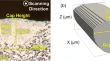
        <description>Cold-rolled dual-phase steels, which belong to the advanced high strength steels, have gained much interest within the automotive industry. The formation of dual-phase microstructure, which provides an optimal combination of strength and formability for automotive applications, occurs during intercritical annealing of cold-rolled strip. Variations in the chemical composition as well as in the heat treatment parameters influence very strongly the microstructure development and therefore the final mechanical properties of the strip. Thus, the precise control of the microstructure evolution during full processing route is required for the achievement of essential mechanical properties. The current work is focused on a through-process model on a microstructural scale for the production of dual-phase steel from cold-rolled strip, which is based on Phase-Field Method and combines the description of ferrite recrystallisation and all phase transformations occurring during intercritical annealing. This approach will enable the prediction of final microstructure for varying composition and processing conditions, and therefore, can be used for the process development and optimisation.</description>
        <link>http://www.immijournal.com/content/1/1/3</link>
                <dc:creator>Ulrich Prahl</dc:creator>
                <dc:creator>Jenny Rudnizki</dc:creator>
                <dc:creator>Wolfgang Bleck</dc:creator>
                <dc:source>Integrating Materials and Manufacturing Innovation 2012, null:3</dc:source>
        <dc:date>2012-08-31T00:00:00Z</dc:date>
        <dc:identifier>doi:10.1186/2193-9772-1-3</dc:identifier>
                                <prism:require>/content/figures/2193-9772-1-3-toc.gif</prism:require>
                <prism:publicationName>Integrating Materials and Manufacturing Innovation</prism:publicationName>
        <prism:issn>2193-9772</prism:issn>
        <prism:volume>${item.volume}</prism:volume>
        <prism:startingPage>3</prism:startingPage>
        <prism:publicationDate>2012-08-31T00:00:00Z</prism:publicationDate>
                <prism:versionidentifier>XML</prism:versionidentifier>
                <cc:license rdf:resource="http://creativecommons.org/licenses/by/2.0/" />
    </item>
        <item rdf:about="http://www.immijournal.com/content/1/1/2">
        <title>Verification and validation of ICME methods and models for aerospace applications</title>
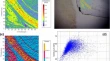
        <description>Integrated Computational Materials Engineering (ICME) model verification and validation (V&amp;V) is difficult because materials processing, microstructural evolution, and property development contain a rich mix of length and time scales with an equally complex set of interacting phenomena and mechanisms. Beyond these difficulties, engineers who adapt these models rarely generate independent validation data sets to confirm model adequacy, quantify uncertainty, and identify potential error sources. Even when a validation data set is produced and applied, the range of model applicability is limited by the range on input model parameters contained within the data set. In this paper we provide a summary of a recommended approach to ICME V&amp;V and include descriptions of V&amp;V planning checklists, an ICME Tool Maturity Level assessment guide and examples of how such practitioner aids might be employed.</description>
        <link>http://www.immijournal.com/content/1/1/2</link>
                <dc:creator>Bradford Cowles</dc:creator>
                <dc:creator>Dan Backman</dc:creator>
                <dc:creator>Rollie Dutton</dc:creator>
                <dc:source>Integrating Materials and Manufacturing Innovation 2012, null:2</dc:source>
        <dc:date>2012-06-11T00:00:00Z</dc:date>
        <dc:identifier>doi:10.1186/2193-9772-1-2</dc:identifier>
                                <prism:require>/content/figures/2193-9772-1-2-toc.gif</prism:require>
                <prism:publicationName>Integrating Materials and Manufacturing Innovation</prism:publicationName>
        <prism:issn>2193-9772</prism:issn>
        <prism:volume>${item.volume}</prism:volume>
        <prism:startingPage>2</prism:startingPage>
        <prism:publicationDate>2012-06-11T00:00:00Z</prism:publicationDate>
                <prism:versionidentifier>XML</prism:versionidentifier>
                <cc:license rdf:resource="http://creativecommons.org/licenses/by/2.0/" />
    </item>
        <item rdf:about="http://www.immijournal.com/content/1/1/1">
        <title>Integrating Materials and Manufacturing Innovation: a new forum for the exchange of information to integrate materials, manufacturing, and design engineering innovations</title>
        <description>A number of contemporary studies have concluded thatthe research and engineering activities across materials,manufacturing, and product design need to be moreclosely coupled to enable responsive product innovationand delivery [1-3]. The recurrent themes in these studiespoint out that the fields of materials and manufacturingmust strive to become more quantitative and predictiveand have to reshape and integrate their engineeringpractices and outputs to better synchronize with productdesign engineering frameworks. This philosophy isstrongly embraced by a relatively new discipline knownas Integrated Computational Materials Engineering(ICME) which seeks to accelerate the development anddeployment of advanced materials [3]. The complexitiesand opportunities of a fully engaged global research andmanufacturing enterprise and the rapid speed of presentday product design cycles demand a new ICME-basedparadigm for how we work, collaborate, and shareknowledge.</description>
        <link>http://www.immijournal.com/content/1/1/1</link>
                <dc:creator>Charles Ward</dc:creator>
                <dc:source>Integrating Materials and Manufacturing Innovation 2012, null:1</dc:source>
        <dc:date>2012-06-11T00:00:00Z</dc:date>
        <dc:identifier>doi:10.1186/2193-9772-1-1</dc:identifier>
                                <prism:require>/content/figures/2193-9772-1-1-toc.gif</prism:require>
                <prism:publicationName>Integrating Materials and Manufacturing Innovation</prism:publicationName>
        <prism:issn>2193-9772</prism:issn>
        <prism:volume>${item.volume}</prism:volume>
        <prism:startingPage>1</prism:startingPage>
        <prism:publicationDate>2012-06-11T00:00:00Z</prism:publicationDate>
                <prism:versionidentifier>XML</prism:versionidentifier>
                <cc:license rdf:resource="http://creativecommons.org/licenses/by/2.0/" />
    </item>
        <cc:License rdf:about="http://creativecommons.org/licenses/by/2.0/">
        <cc:permits rdf:resource="http://creativecommons.org/ns#Reproduction" />
        <cc:permits rdf:resource="http://creativecommons.org/ns#Distribution" />
        <cc:permits rdf:resource="http://creativecommons.org/ns#DerivativeWorks" />
    </cc:License>
</rdf:RDF>